


Structuring 529 portfolios by expected enrollment date—rather than by age—gives families more flexibility to pinpoint their education timeline and helps manage the risks of market downturns.
Executive summary
Saving for education remains one of the most pressing financial challenges confronting families today, especially as the cost of higher education continues its upward trajectory. To help families prepare for this expense, 529 plans offer two leading solutions—age-based and enrollment-based investment portfolios—which automatically adjust asset allocations based on the beneficiary’s age or anticipated enrollment date. Both approaches typically become more conservative as the time to tuition draws near, aligning with the goal of protecting accumulated savings.
In this paper, we analyze these two portfolio strategies. Although both yield comparable long-term outcomes over an 18-year investment horizon, the expanding scope of 529 plans—including uses for K-12 tuition, college preparation, apprenticeships, and more—highlights the potential advantages of enrollment-based portfolios. Specifically, this approach can offer participants a more precise way to align their investments with the actual timeframes when they intend to access their 529 accounts, supporting a range of educational objectives.
Key advantages of enrollment-based portfolios
- They mitigate market risk by gradually reducing equity exposure each year, so families aren’t forced to make big changes during unpredictable market swings.
- They offer greater flexibility for families, allowing them to choose portfolios aligned with their child’s specific education needs—from college and graduate school to more immediate education expenses.
- They simplify communications and oversight, as participants remain in the same portfolio rather than switching to a new age-based option as the beneficiary grows older.
Two approaches to 529s
Age-based portfolios
Each age-based 529 portfolio is constructed for a fixed age cohort (e.g., ages 0-4, ages 5-8, etc.). That means the risk/return profile for each portfolio remains consistent over time. This structure makes performance benchmarking straightforward for plan sponsors and consultants, since the portfolio does not adjust equity every year.
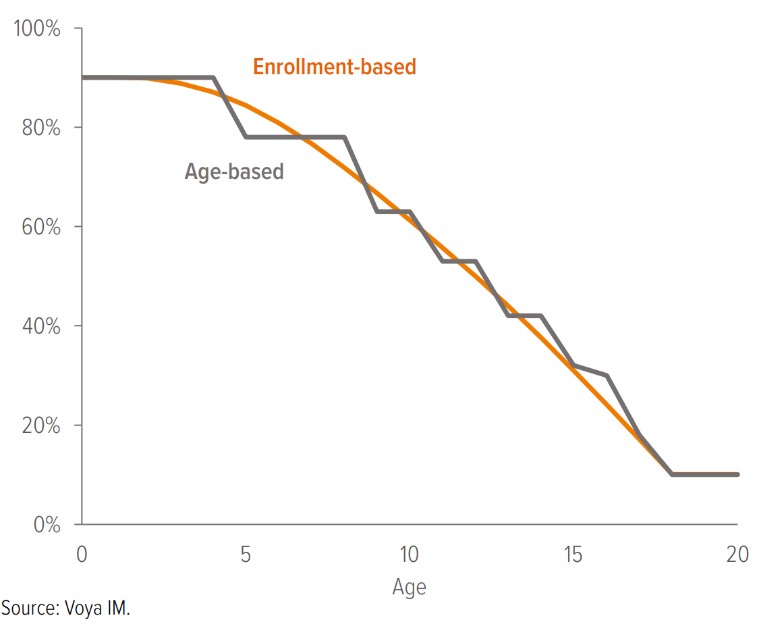
When the beneficiary ages out of their cohort, they are moved into a new portfolio, resulting in an allocation change at each transition (Exhibit 1). Additionally, age-based portfolios typically assume that all beneficiaries will enroll in college at age 18, which may not apply to students who skip a grade or delay enrollment. And because 529 plans can also be used for K-12 and graduate education, the actual enrollment age could potentially be much earlier or later than 18.
Enrollment-based portfolios
Enrollment-based portfolios are structured according to a specific enrollment year (such as 2026-2027 or 2028-2029). This approach ensures that the investment strategy aligns with the beneficiary’s actual tuition savings goal—whether that is tuition for high school at age 14, college at age 18, or graduate school at age 22.
Risk is gradually reduced each year, resulting in smaller, incremental changes to the portfolio’s asset allocation. Beneficiaries remain in the same fund throughout their saving period, providing a more seamless experience and making it easier for families and advisors to understand and communicate the plan’s progress.
Exhibit 1: Enrollment-based portfolios offer a smoother glide path
Equity weight by age
Both produce similar outcomes in “typical” markets
Drawing on Voya’s lifecycle investing model, our simulations suggest that, on average, enrollment-based and age-based glide paths deliver nearly identical investment outcomes at the end of the 18-year horizon. Starting with the same 50,000 macroeconomic and financial market scenarios used to construct our 529 glide path,1 we analyzed both age- and enrollment-based glide paths to produce the distribution of account balances at enrollment. For this analysis, we assumed that the beneficiary expects to enroll at age 18.
As shown in Exhibit 2, the median outcomes were essentially the same, netting $294 (or 0.2% of the total account balance) more for age-based portfolios than for enrollment-based portfolios. But the average only tells part of the story. What happens if a downturn comes just at the wrong time?
Exhibit 2: On average, outcomes of the two strategies are nearly identical
Median portfolio balance after 18 years in nominal dollars
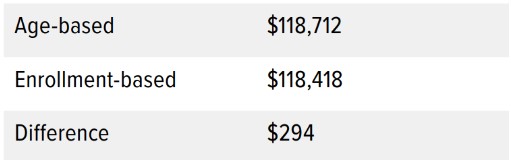
As of 06/30/25. Source: Voya IM. Median outcomes based on stochastic analysis of portfolio balances from 50,000 economic and capital market scenarios. Assumptions: Voya 2025 equilibrium capital market expectations; starting age of 0 and enrollment age of 18; spending target based on four years of average private/ public undergraduate tuition, fees, housing, and food; savings target is 32% of spending target; contribution amount is 6% of savings target per year (18 years of annual contributions) real tuition inflation of 2.2%, with 2.8% standard deviation.
Mitigating market shocks
Despite delivering a similar result on average, age-based portfolios face higher market timing risk because they have larger steps down in equity holdings. The most significant change in an age-based glide path happens when the beneficiary reaches age nine, when the equity allocation drops by 15% (compared with just a 5% decrease for the enrollment-based glide path). If a downturn were to occur right before the bigger step-down, investors in age-based portfolios would lock in a more substantial loss by selling equities after the drop. Conversely, these investors would lock in a larger gain if the market were up significantly right before the step-down.
To quantify how market timing risk can erode long-term outcomes, the stress test in Exhibit 3 isolates the impact of abrupt equity step-downs in age-based 529 portfolios. Using the 50,000 simulated market paths from our scenario analysis, we identified instances with (i) a 15% or greater equity loss in year 9 and (ii) a 15% or greater rebound in year 10, coinciding with the timing that age-based portfolios sharply reduce their equity allocation.
In these 1,069 “shock” scenarios, age-based savers sold equities after a steep decline, locking in losses and missing the subsequent recovery. Exhibit 3 highlights the financial impact at key ages. At age eight, both portfolio types have similar balances. By age nine, age-based portfolios fall $516 behind enrollmentbased portfolios. After the rebound at age 10, the gap widens, with age-based portfolios trailing by $983. By enrollment at age 18, age-based ends up $1,127 lower than enrollment-based portfolios.
This analysis illustrates that enrollment-based portfolios, which reduce risk more gradually, help beneficiaries avoid the potential drawbacks of having to sell during market downturns and allow for better participation in market recoveries.
Exhibit 3: Market-timing risk in action
Median portfolio balances in drawdown scenarios, in nominal dollars (1,069 scenarios)

As of 06/30/25. Source: Voya IM. Median outcomes based on stochastic analysis of portfolio balances from 1,069 economic and capital market scenarios. See Exhibit 2 for assumptions.
Greater flexibility for families
Perhaps most importantly, enrollment-based structures help families prepare for a wider variety of education expenses. Consider these scenarios:
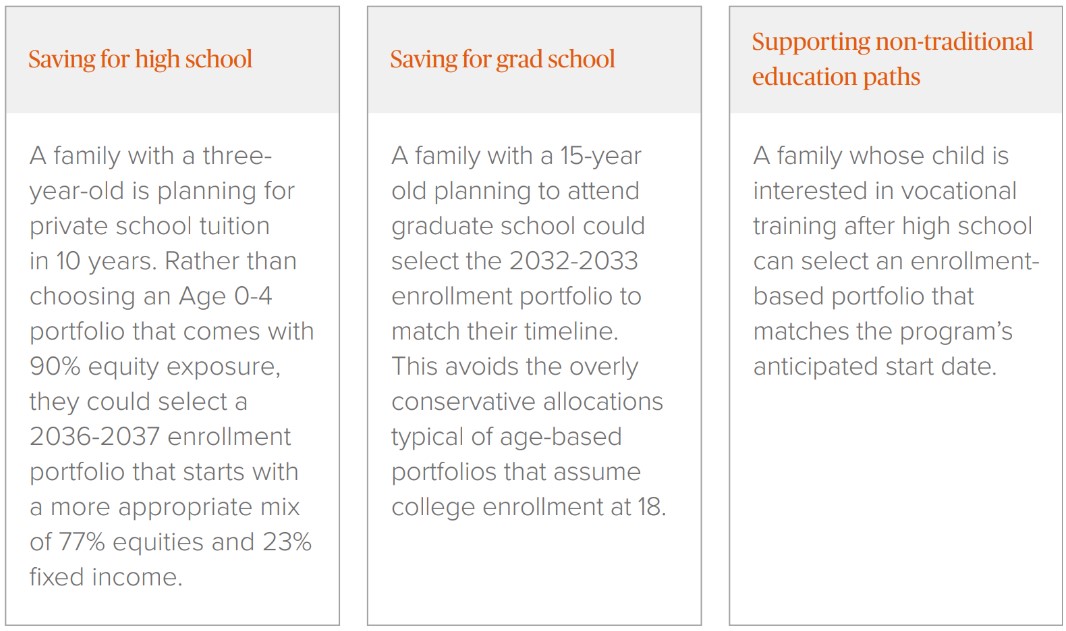
Furthermore, enrollment-based portfolios help simplify oversight and communication. Investors and advisors can more easily track progress because beneficiaries remain in the same portfolio until their intended enrollment date—there’s no need to switch to a new age-based option as the beneficiary grows older.
The 529 landscape is evolving
According to a recent study by ISS Market Intelligence,2 25% of parents are now leveraging 529 plans for new purposes—including K-12, apprenticeships, vocational training, student loan repayments (permitted in 529s since 2019), and even Roth IRA transfers (permitted in 529s since 2024).
As education financing options expand and diversify, enrollment-based portfolios stand out for their ability to meet the needs of today’s families. By combining thoughtful risk management, streamlined operations, and forward-looking flexibility, these portfolios empower savers to confidently prepare for their children’s futures—no matter where their educational journeys may lead.
A note about risk: Investments in 529 plans are not guaranteed or insured and are subject to investment risks, including the loss of the principal amount invested.
The tax information contained herein is not intended to be used as tax-planning advice, nor can it be used by any taxpayer for the purpose of avoiding tax penalties. Taxpayers should seek advice based on their own particular circumstances from an independent tax advisor.

1Note: For details on how Voya constructs its 529 Plan glide path, please see “Plan Today, Thrive Tomorrow.”
2 ISS Market Intelligence, “529 Industry Analysis 2025”.
Past performance does not guarantee future results. This market insight has been prepared by Voya Investment Management for informational purposes. Nothing contained herein should be construed as (i) an offer to sell or solicitation of an offer to buy any security or (ii) a recommendation as to the advisability of investing in, purchasing or selling any security. Any opinions expressed herein reflect our judgment and are subject to change. Certain statements contained herein may represent future expectations or other forward-looking statements that are based on management’s current views and assumptions and involve known and unknown risks and uncertainties that could cause actual results, performance or events to differ materially from those expressed or implied in such statements. Actual results, performance or events may differ materially from those in such statements due to, without limitation, (1) general economic conditions, (2) performance of financial markets, (3) interest rate levels, (4) increasing levels of loan defaults, (5) changes in laws and regulations and (6) changes in the policies of governments and/or regulatory authorities. The opinions, views and information expressed in this commentary regarding holdings are subject to change without notice. The information provided regarding holdings is not a recommendation to buy or sell any security. Fund holdings are fluid and are subject to daily change based on market conditions and other factors.